
The Next Step in Sustainable Construction
The construction industry stands at a critical intersection of technology, sustainability, and human design. As urban populations expand and global energy demands surge, buildings are no longer just structures — they are active ecosystems expected to generate, conserve, and intelligently manage energy.
Among the most exciting innovations reshaping this reality is piezoelectric flooring — a technology that converts mechanical pressure from footsteps and movement into electricity.
For decades, the notion of floors that create power seemed futuristic. Today, it is a rapidly developing technology finding its way into transportation hubs, sports arenas, educational institutions, and public plazas. Beyond novelty, piezoelectric flooring embodies the construction sector’s push toward decentralized, renewable energy systems and smart infrastructure integration.
Understanding the Science Behind Piezoelectric Floors
The term piezoelectric comes from the Greek word piezein, meaning “to press.” The piezoelectric effect, discovered in the 1880s by Pierre and Jacques Curie, describes the ability of certain materials — such as quartz, ceramics, or specially engineered polymers — to generate an electrical charge when mechanically stressed.
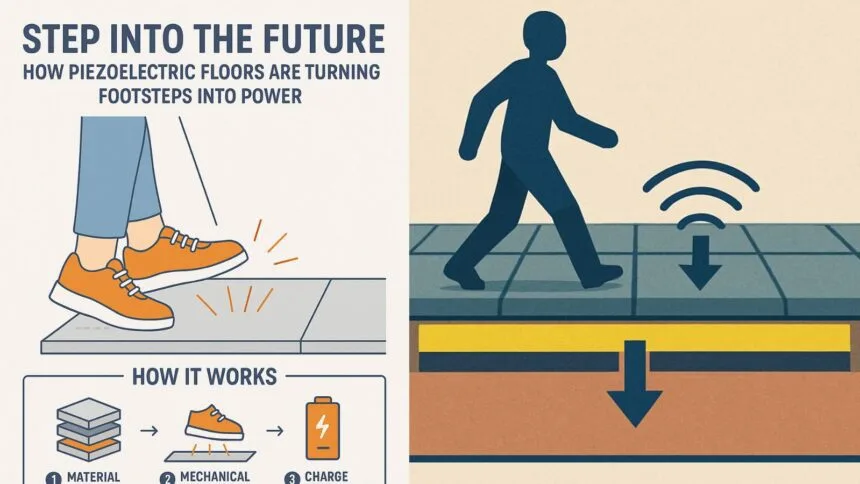
In simple terms, when a person walks, runs, or jumps on a piezoelectric tile, that movement compresses a layer of piezoelectric crystals beneath the surface. This mechanical pressure produces an electrical voltage that can be captured, stored, and reused.
The process typically follows four stages:
- Mechanical Induction: Pressure is applied to the piezoelectric material embedded beneath the floor’s surface.
- Charge Generation: The molecular structure of the material deforms slightly, releasing electrons and creating an electric potential.
- Energy Capture: Circuitry embedded within the floor collects and channels this energy.
- Storage or Direct Use: The energy is stored in batteries or used immediately to power local systems like lights, screens, or sensors.
While each step only produces a few milliwatts, the cumulative effect in high-traffic areas — train stations, airports, stadiums — can generate meaningful, continuous energy output.
Engineering the Smart Floor
A modern piezoelectric floor system is a multi-layered structure engineered for durability, safety, and efficiency. The base typically includes:
- Surface Layer: Made from tough, slip-resistant materials (ceramic, composite, or recycled polymer).
- Piezoelectric Layer: Contains tiles or films embedded with active piezoelectric elements, such as lead zirconate titanate (PZT) or polyvinylidene fluoride (PVDF).
- Electrode and Wiring Network: Collects the generated charge and channels it to a controller or converter.
- Energy Management System: Directs power either to a storage device or to power loads directly.
Construction professionals play a key role in integrating these layers into the structural design — ensuring that mechanical stresses are evenly distributed and that the system remains safe under varying loads and environmental conditions.
Durability testing, compression analysis, and long-term fatigue simulations are essential parts of the installation process.
Real-World Applications: From Concept to Construction
The potential applications for piezoelectric flooring span nearly every segment of the built environment. What began as an experimental concept is now demonstrating measurable results in large-scale pilots and public spaces around the world.
1. Smart Cities and Public Infrastructure
Urban planners in cities such as London, Tokyo, and Seoul have begun integrating piezoelectric systems into busy walkways and transit hubs. Train stations and airport corridors, where millions of footsteps occur daily, are ideal for energy harvesting.
These installations often power LED lighting, information screens, and emergency signage — demonstrating how micro-energy generation can contribute to larger sustainability goals.
2. Commercial and Retail Buildings
For commercial developers, piezoelectric flooring offers both functional and marketing advantages. Shopping malls and corporate campuses have used kinetic floors to power advertisements or offer “walk-to-charge” phone stations.
The visible link between movement and power generation strengthens the brand’s sustainability narrative and helps meet ESG (Environmental, Social, and Governance) targets.
3. Educational and Institutional Settings
Universities and schools are emerging as testbeds for piezoelectric technology. Beyond powering campus facilities, they serve as living laboratories for teaching environmental engineering, physics, and renewable energy concepts.
4. Sports, Events, and Entertainment Venues
Few places generate as much collective movement as stadiums or concert halls. Piezoelectric floors in these venues can harness thousands of synchronized steps or jumps, transforming crowd energy into electricity used for lighting or digital effects — literally allowing spectators to power the show.
5. Residential and Smart Homes
Although not yet mainstream, research is moving toward using piezoelectric floors in off-grid or smart home environments. In kitchens, entryways, or corridors, everyday motion could power ambient lighting or IoT sensors, contributing to net-zero housing designs.
Benefits for Construction and Design Professionals
For builders, developers, and architects, piezoelectric flooring aligns with several modern construction priorities:
1. Embedded Sustainability
Unlike solar panels or wind turbines, piezoelectric floors require no additional land or visual space. They transform an existing architectural element — the floor — into an energy source.
2. Low Maintenance and Longevity
Once installed, piezoelectric tiles demand minimal maintenance. The materials used are resistant to wear and environmental degradation, making them a long-term sustainable investment.
3. Enhanced Public Engagement
Real-time displays that show how much energy users generate help foster environmental awareness and public participation in sustainability initiatives.
4. Design Flexibility
Available in tile, mat, or modular panel formats, these systems can be adapted to various building types and aesthetics, from industrial walkways to luxury interiors.
5. Energy Independence
In remote or emergency contexts — such as shelters or temporary installations — piezoelectric flooring can provide a modest but reliable source of off-grid energy.
Challenges and Limitations in Construction
As with any emerging technology, implementation comes with practical challenges that construction professionals must evaluate early in the design process.
1. Cost and Scalability
The cost of piezoelectric materials and embedded electronics remains higher than conventional flooring systems. Large-scale deployment is currently limited to high-traffic areas where energy yield justifies the expense.
2. Energy Output
Although energy generation is continuous, the output per square meter remains modest. Effective use depends on strategic placement — high-density pedestrian zones offer the best return on investment.
3. Structural Integration
Piezoelectric systems must be properly integrated into floor assemblies to ensure both electrical safety and structural performance. Collaboration between architects, engineers, and electricians is crucial.
4. Durability and Maintenance
Mechanical fatigue and environmental wear can affect material performance over years of use. Manufacturers are investing heavily in developing flexible, high-durability composites that maintain charge sensitivity over time.
Innovation and Future Development
The research frontier for piezoelectric flooring is expanding rapidly. New materials, manufacturing methods, and digital integrations are driving performance improvements.
1. Advanced Materials
Scientists are experimenting with nanostructured ceramics, thin-film composites, and organic polymers that deliver higher energy density and greater flexibility. These materials promise lighter, more resilient systems with longer lifespans.
2. Hybrid Energy Systems
The next generation of smart buildings will likely combine piezoelectric flooring with solar panels, thermoelectric modules, and energy storage units. Such systems can create multi-source microgrids, improving energy resilience and reducing dependence on external power.
3. IoT and Data Integration
When connected to Internet-of-Things (IoT) networks, piezoelectric floors can act as sensors as well as energy sources — tracking occupancy, foot traffic, and even load distribution. This data can optimize HVAC systems, security monitoring, and lighting efficiency in real time.
4. Wireless Power Transfer
Researchers are developing wireless energy transfer systems that could send piezoelectric-generated electricity directly to local grids without extensive cabling, reducing installation complexity and improving scalability.
Economic and Environmental Impact
Beyond technical benefits, piezoelectric flooring contributes to broader sustainability goals:
- Reduced Carbon Footprint: The system generates renewable power with zero emissions.
- Lifecycle Efficiency: Its long lifespan offsets the embodied energy of installation materials.
- Public Value: Deploying visible, participatory energy systems strengthens a city’s sustainability profile and public trust.
- Green Building Certifications: Projects integrating piezoelectric systems can earn points toward LEED, BREEAM, or WELL certifications under innovation and energy categories.
For developers, this means a tangible ROI through brand reputation, tenant appeal, and potential government incentives for renewable innovation.
The Role of Construction Professionals
Integrating piezoelectric flooring requires interdisciplinary collaboration — civil engineers, architects, electricians, and sustainability consultants all play critical roles.
Design teams must assess load capacities, wiring layouts, and electrical safety. Project managers must coordinate with suppliers to ensure material compatibility and compliance with building codes.
For contractors and builders, early involvement in design discussions ensures seamless integration without costly retrofitting later.
As the technology matures, it will likely become part of standard specifications for smart city infrastructure and next-generation green buildings.
The Future of Energy-Responsive Architecture
Piezoelectric flooring is part of a larger movement toward energy-responsive architecture — structures that interact with their occupants and environment to optimize energy use.
Imagine a building where walking down the hallway powers ambient lighting, where escalators adjust speed based on foot traffic, or where flooring systems collect data to guide facility management decisions.
The convergence of materials science, AI, and sustainable design is paving the way for buildings that are not just energy-efficient but energy-productive — producing as much energy as they consume.
Conclusion: Powering the World, One Step at a Time
For construction and engineering professionals, piezoelectric flooring represents a powerful opportunity to redefine how energy is generated and consumed in the built environment.
It embodies the spirit of modern construction — blending structural ingenuity, environmental stewardship, and digital intelligence into a single system.
As cities strive for net-zero energy goals, the ability to harvest power from movement could become an integral piece of the energy mosaic.
Every footstep, every vibration, every motion becomes more than an act of movement — it becomes an act of creation.
The future of energy may not just lie above us in the sun or around us in the wind — but beneath our very feet.